Friday, January 20, 2012

Monday, January 2, 2012

Ometepe New Year


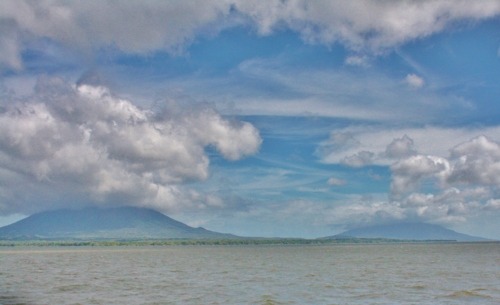
I could hardly put down my travel guide for the entire time we were on the ferry moving about six knots towards San Jorge.  La Concepcion loomed overhead with her summit enveloped in clouds.  Ometepe Island, our destination, was about to fulfill everything that I had been reading about and much much more.  

            Once again with my beautiful girlfriend and more than generous “suegros” (her parents), we were off again on another adventure.  We had gotten up extra early that morning, woofed down some quick breakfasts and started driving down to Rivas, Rivas to catch the first ferry we could.

            The ferry, La Reina del Lago, came into port, dropped her large back doors like a draw bridge over a mote, and we all poured inside.  La Reina wasn’t a particularly big ship, and the crowd of Nicas and Gringos had me wondering if we’d all fit.  But fit we did and for the next two hours or so were spent elbow to elbow with the other passengers as we watch the twin volcanoes getting closer and closer.

            Oscar, Kathya’s dad, was smart enough to bring the family truck along.  It cost quite a bit more but it was a saving compared to the prices of public transport on the island, plus we’d be in much better control of when and where we went.  Since we were only going to stay one night that mad things much easier to maximize our time.

            Here’s a little info about Ometepe.  The island sits in the western half of Lake Nicaragua.  It gets its Nawatl name, Ometepe, from its twin volcanoes that make up the island; the name means Twin Mountain.  Its beautiful forests and jungles and amazing wildlife have earned the island a place in the top ten natural wonders of the world.

            After checking into our hotel, we immediately set out to explore.  The first place we went to was a swimming hole called Ojo de Agua.  The Nicas on the island only swim in the swimming holes such as this one.  The lake is the domain of bull sharks.  But one look at the crystalline waters of Ojo de Agua and I was quite content to swim the day away right there.  There was even a rope swing, but unfortunately as with any attraction there were lines waiting for it.  

            The next day began with a breakfast of packed fruit and coffee.  The hotel staff were also carrying out uneaten food out behind where we were sleeping and I heard Kathya’s parents say that they we feeding the monkeys.  I wasted no time grabbing my camera and  rushing to the scene, and sure enough, there were about eight or so spider monkies coming down from the trees taking the leftovers and gorging on the fruit.  I even made a major naturalist “no no” and fed one of the braver monkies by hand.  It was totally worth it.

We eventually left our furry friends to eat and headed out to the swampy nature preserve of Charco Verde.  On the beaches of the island facing east, the waters hardly move and nothing could be heard but the forests around.  We trekked back into the preserve until we could go no further due to the thickening of the brush in our path and the mud on our shoes.  There supposedly is a witch doctor that lives in the area but we weren’t lucky enough to spot him.

            Finally it was my turn to pick the next destination.  With my obsession for history and antiquities, I made Kathya and the others go to an archaeology museum that was devoted completely to Ometepe finds.  At first, the more than doubled price for me as a gringo had me a bit put off but as soon as I started seeing art and artifacts, I was immediately placated.  Among the many pots, tools and other things typical of a museum, I saw an object that was about as long as my forearm and had some sort of joystick like grip on one end.  I asked the one of the guides what it was, and she seemed a bit embarrassed.  “It was a tool for the women, for when their husbands leave to go to work or war for a long time…”  That’s right, it was pre-Colombian dildo!  The other guide was much more enthusiastic.  I asked her what some of the little holes on shaft were for.  She plainly answered, “they’re for putting toys on it.  No pain means no pleasure.”  I won’t lie.  When she said that, my first thoughts were, “I can see what you’re into.”

            Finally the time had come for us to retreat from this amazing island escape.  Whether it be for the beautiful crystal waters of Ojo de Agua or the ancient ceramic lady toy, I know I’ll be remembering this little island adventure for a long time and hopefully return to.

Saturday, December 10, 2011

Playing with Petroglyphs


Almost on a whim, I asked my counterpart if he had heard about the glyphs.  From the giddy look on his face, I could tell that a trip down to the banks of the Rio Miko is in our near future.
Cara de Mono is a tiny little farming town on the road to Rama, RAAS.  Rio Miko supplies it and all the other communities in the area with water, and also a little something else that only a few travelers have ever ventured off the roads deep enough to find it.
            Moises and I called up my sitemate, Jake, to see if he was down to see some petroglyphs.  Of course he said yes and about 30 minutes later, we were getting out of a taxi in the tiny community of Cara de Mono, or in English, monkey face. 
            The town is really more like a bus stop with a few houses built around.  There’s a corner store, a cell tower and that’s about it.  We wandered off the highway towards one of the houses.  Moises asked one of the boys in the house if he could show us the “famous” petroglyphs.  The boy, Jose, seemed happy to have a reason to get out of the house and so off we went.
            We spent about 15 minutes walking along the highway passing nothing but trees.  The RAAS is a part of Nicaragua that is massively under developed.  Combined with its northern sister state, RAAN, the two make up more than 50% of the land of the country.  However, the population is something along the lines of 10%.  So as we walked down the highway, it was rare that we passed anything other than the natural landscape. 
             Finally we reached the cemetery, a long flight of steps to get up to the plateau where the graves were.  Then our journey took us off roads completely.  We pushed our way through trees, shrubs and long grass that apparently cows frequented by the amount of pies Jake and I narrowly avoided stepping in. 
We passed pools that were homes to caimans, Central American crocodiles.  None made their presence known to us, but Jose was quite wary of them and we passed the pools quickly.
            After about 20 minutes we had reached the Miko.  We slid down rocks as slick as soapy glass cup, and made our way to the banks of the river.  Following the current, we swung under low hanging trees and climbed over boulders bigger than my bed until we reached a peninsula of rocks that jutted out into the river. 
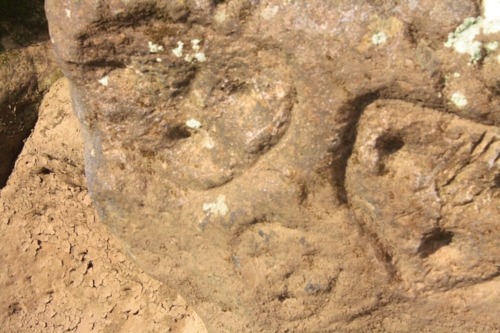
            This was the place we had been hiking through such rugged terrain to find.  On almost every other stone was an articulately drawn monkey face or abstract shape that spiraled over the surface or the rock.  Rather cartoonish looking and certainly not as glamorous as the carvings at Tikal or Chitchen Itza, but some were still in very good condition for being on the banks of a river that would be wearing them away wet season after wet season, century after century. 
            I try normally to not look to touristy when I’m around Nicaraguans to keep my street cred.  But in the presence of basically unexcavated pre-Columbian rock art, I was ecstatic, snapping my giant tourist camera and jumping at anything that looked like a scratch on the rock to see if it was some undiscovered piece of stone art. 
            As the time went on, and we had seen all there was to see, Moises, Jose, Jake and I decided it was time to start back up the river.  We wanted to be out of the jungle before it got too dark to see where we were going or worse, Jose’s fabled caiman.